
Hola!
It’s revision/review time – Last year we emailed some of you about Spanish for snacks, and we wanted to make sure you all get this great Spanish language information:
It can often be confusing how the Spanish can have 3 different ways to say the same thing!
Having a between-meals snack is a classic example.
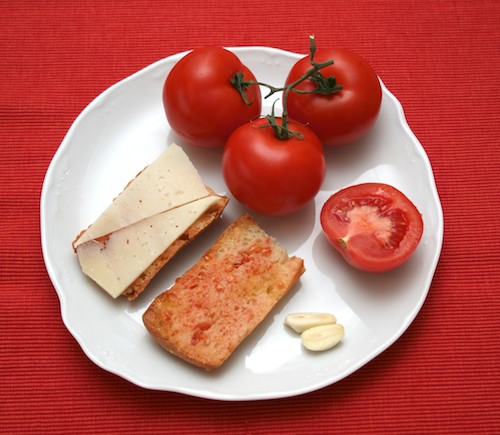
If I (Ben) am investigating the fridge for a snack Marina might say to me either of the following things:
Hmmm, hazme un piscolabis también…
A mi también me apetece un tentempié…
If it’s afternoon teatime, she’ll probably use ‘merienda’:
¿Vas a preparar la merienda?
So, piscolabis and tentempié are both wonderful sounding words used here in Spain for between-meal snacks and merienda is more for teatime, though it could be used for a morning snack in the context of what you send a child off to school with to keep her going until lunch.
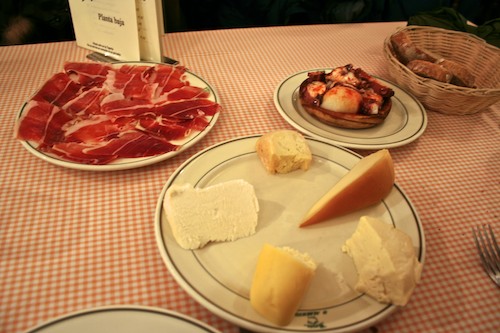
The verb is often used too – voy a merendar algo, and the Spanish often talk about having an early merienda-cena, a ‘high-tea’ that fills you up enough to not need a proper supper later.
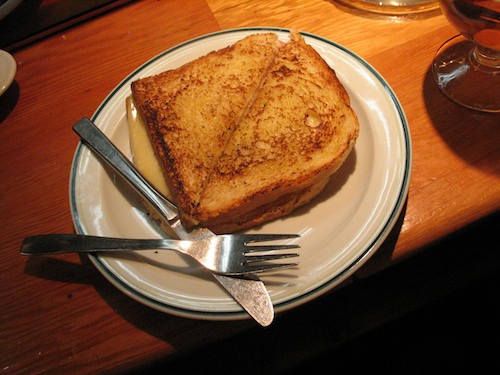
So snacking in Spain can sound like a complex business, but we like to make sure you are aware of all the variations!
Try using these in real life Spanish conversations!
Saludos desde Madrid,
Ben y Marina

Muy util, gracias. Tenemos muchas amigas-vecinas buenas y a veces, como inglés, hemos tenido problemas con la horario español para invitarlos a nuestra casa. Hora será mas facil.
Hola..
so would the following list make sense? desyuno, tentempie, piscolabis, almuerzo, merienda,( mierienda cena), tapas, cena, carpanta. While some of these nouns have common sounding verbs, what about the others? And what is the equivalent of ‘coffee break’ meaning the break at the office, in Spanish?And tea-party or tea cermony ?
Gracias por las explicaciones..Que venga el verano!!
I recently signed my child up for the local summer programme, and came across this word in the Spanish section of the information I was given. (The same word also appeared in the Euskara section)
Hamaikehakoa – which according to my Euskara speaking colleagues means mid-morning snack, as hamaika is the Basque word for 11.
so delicious
elevenses se llama en espanol las onces.
Wow..! By the pics, recipe looks too much yummy. I want to add this to my store menu list. Thanks for sharing a great recipe tips or snacks tips.
@ Jane,
Except carpanta (I haven’t heard this word used in this context before. I also checked the dictionary and the meaning is still not clear for me) the rest are perfect.
Verbs would be:
desayunar
tomar un tentenpie, un piscolabis, unas tapas (a veces tapear)
comer / almorzar
cenar
Coffee break would be translated as: “El café”, for example “el café de la mañana” or “el café de la tarde” or simply by saying “una pausa”. “¿Hacemos una pausa?”.
As the tea is less in our culture I would translate it by “El café” too”, “¿Venís a tomar un café a casa?”.
I hope it helps,
Marina.
@ Alison,
I’m not sure I understood right, I gather that they used the euskera word in the Spanish section… that tells that there is not a perfect translation for it.
Yes Marina, that’s right. I tried looking it up in the Spanish dictionaries I have and online as well. “tomen un hamaiketako que traigan dessert su casa”. I wonder why they don’t use piscolabis or tentempie as they use merienda for the kids after school snack. Then again we also have pintxos here rather than tapas.
what interesting words and as ever lovely photos. I have also enjoyed reading the comments. I was interested in the Basque word referred to and found this link:
http://www.conocerbilbao.com/tag/hamaiketako/
Pat
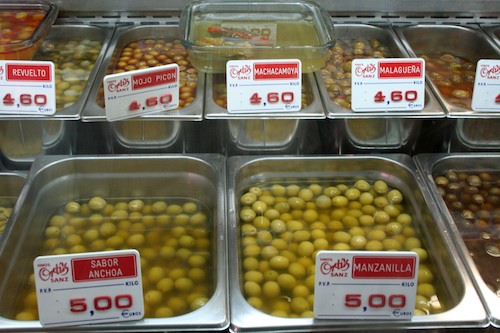
what is the top photo? Are those olives? And do the signs indicate different sorts of marinades or something? I know one says “chamomile” – which seems an odd flavoring for olives… please explain
@Ann – yes, they are olives, and the words refer to different types, like Manzanilla, or marinades, like mojo picon.
5 years living in Madrid and I hadn’t heard piscolabis before. Thanks for the new word!
Is ‘almuerzo’ the equivalent of our ‘elevenses’ ?
Almuerzo is actually used with two different meanings:
From the RAE:
1. m. Comida que se toma por la mañana. –> That is elevenses
2. m. Comida del mediodía o primeras horas de la tarde. —> Lunch
Reading the comments is like going to a teacher workshop every day! Love what you are doing for us!
Thanks Linda – I love reading comments like yours too!